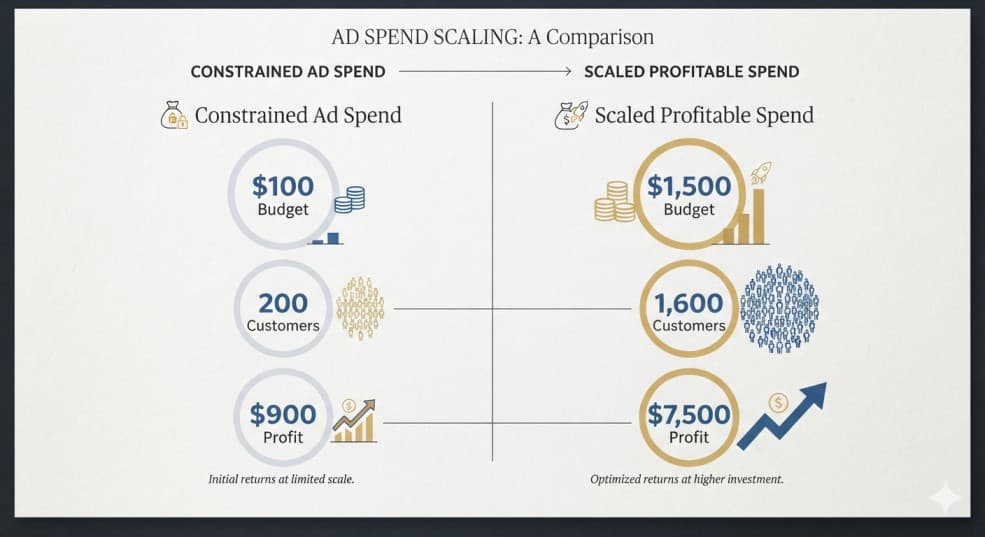
TL;DR: Most brands obsess over ROAS and ignore profit, costing them customer acquisition and long-term growth. Calculate your break-even ROAS (accounting for all costs), add your desired profit margin, then spend aggressively to that target instead of chasing inflated ROAS numbers. The math is simple: lower ROAS targets allow 10x higher spend and 2x more customers, meaning more revenue, better economies of scale, and genuine word-of-mouth growth.
There's a critical issue with your ad account that's costing you money each month. Most brands I talk to focus on return on ad spend and overlook how much profit actually hits their bank account. They'll see a 3x ROAS and panic, thinking they've failed, when in reality they might be making more profit than ever. The gap between ROAS obsession and profit reality is where most businesses leave their biggest wins on the table.
Why ROAS Alone Is Destroying Your Growth
ROAS is just an efficiency metric, not a success metric. It tells you whether you're losing money on each sale. Nothing more. When you anchor your entire ad strategy around hitting a specific ROAS number instead of hitting a profit number, you're optimizing for the wrong outcome. You're making your ad account smaller, acquiring fewer customers, and missing out on the compounding benefits of genuine scale.
I constantly see brands doing this. They hit a 10x ROAS last year, and now they're hitting an 8x, so they cut spend to address the drop. What they never calculate is whether they're actually making more total profit at the 8x. Spoiler: they usually are. But because they're so locked into the ROAS number, they make decisions that shrink their business instead of growing it.
The Real Problem with ROAS Obsession
Chasing a high ROAS number is like deciding your business goal is to make $900 instead of $1,000. It makes no logical sense once you see the numbers written out. If you can spend $1,000 on ads and make $1,000 in profit instead of spending $100 and making $900, which one do you pick? Every rational business owner picks the $1,000. Yet that's exactly what's happening when you refuse to lower your ROAS target.
The brands that truly scale understand one thing: more customers means more word of mouth, cheaper per-unit production costs, stronger negotiating power with suppliers, and data you can use to optimize your entire business. These are the invisible benefits that never show up in your ROAS calculation but compound into massive competitive advantages over time.
Calculate Your Break-Even ROAS First
Your break-even ROAS is the threshold below which you start losing money on every sale. To find it, add up every cost associated with getting that customer to your checkout: cost of goods, packaging, shipping, payment processing, fixed overhead, customer service. Everything. Then divide your revenue by that total cost. That's your break-even number. Let's call it your BE ROAS.
Here's a concrete example from my own testing. A brand making a physical product had these costs per unit sold: $15 COGS, $3 shipping, $2 processing fees, and after accounting for fixed costs and overhead, another $10 per unit. Total cost per customer: $30. If they're selling at $60, their break-even ROAS is 2x. They need $2 in revenue for every $1 they spend on ads to make $0 profit and break even.
Most brands have never calculated this number. They're flying blind, chasing a ROAS target they read about online without understanding what their actual break-even is. That's step one: know your number. Calculate it right now if you haven't already.
Add Your Profit Margin to Create Your Real Target
Once you know your break-even ROAS, add the profit percentage you actually want to make. This is where most people go wrong. They think "I should make 50% margins on ads," which is often impossible at scale. Be realistic. If your break-even ROAS is 2x and you want to make 10% profit on that, multiply 2 by 1.1, which gives you 2.1x. That's your target ROAS. Every dollar you spend at 2.1x and above is profitable. Anything above that is extra margin.
I watched a brand recalculate this last month and realize they could lower their ROAS target from 4x to 2.2x. They were shocked. They'd been constraining their spend for two years chasing a number that had no basis in their actual profit structure. Once they recalibrated and started spending at 2.2x instead of 4x, they went from $150 ad spend per day to $1,500. In three months, their customer base tripled.
The math is brutal once you see it. If your ROAS target is 4x but your break-even is 2x, you're only using half your available spend capacity. You're intentionally staying small when you could be 5-10 times bigger.
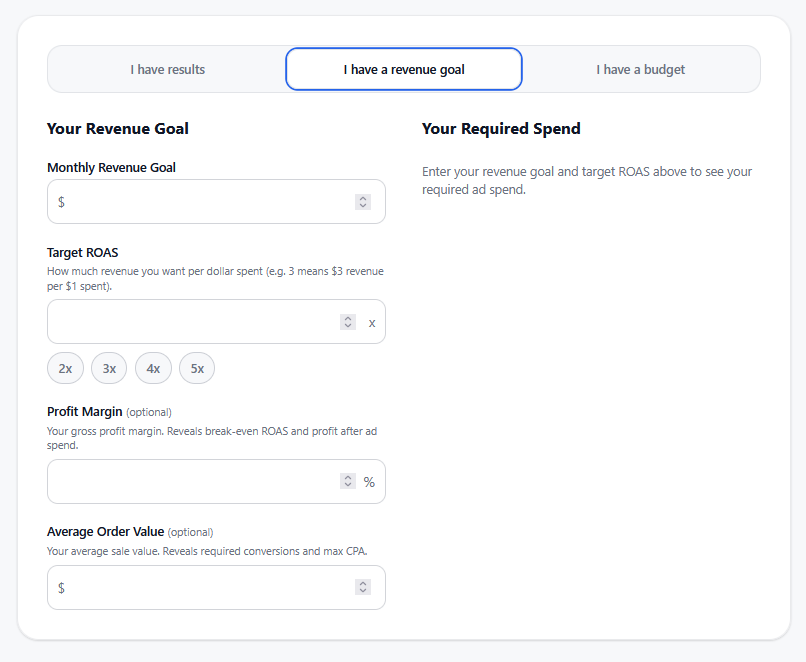
Stop guessing. Calculate your real ROAS target now.
Use our free ROAS Calculator to find your break-even number and actual profit target in 2 minutes. No signup required. Just your numbers, your profit.
Scale Spend Aggressively Once You Hit Your Real Target
This is where the actual growth happens. Once you're consistently hitting your target ROAS, your only job is to spend more money. Not optimize harder. Not change your creative. Spend more. Every dollar above your target ROAS compounds into profit and customer acquisition.
The scaling math works like this. If you're hitting a 2.1x ROAS and you can spend $1,000 instead of $100, you generate $2,000 in revenue instead of $210. That's $900 in profit instead of $60. But here's where it gets better. Those 5-10 extra customers who discovered your brand at the lower ROAS? They talk to their friends. Word of mouth compounds. You've reached 5-10 times more people. Your unit economics improve. Your supplier costs drop because you're ordering in larger volume. Your customer service cost per user drops. These downstream benefits are worth more than the ad profit itself.
I saw this play out with a D2C apparel brand. They increased spend from $3,000 to $30,000 monthly by lowering their target from 3.5x to 2.3x. Their ROAS appeared to drop. But they went from 200 customers per month to 800. Those 800 customers talked. Six months later, 40% of their new customers were coming from referrals. Their actual blended ROAS, including organic referral traffic, hit 4.2x. They scaled by going lower.
Ready to scale but not sure how? FastiAds helps brands calculate their real ROAS target, then scale ad spend across Facebook, Instagram, and Google without leaving profit on the table. We handle the math and the execution.
Scale profitably with FastiAds.
Frequently Asked Questions
What if my break-even ROAS is higher than my current ROAS target?
You're currently losing money on every sale. Stop spending immediately and either raise prices, lower your costs, or reevaluate your ad efficiency before scaling. Your current ROAS target is a false sense of security.
Doesn't lowering ROAS targets force me to reach lower-quality customers?
No, it forces you to reach more customers at the same quality threshold. You're not changing who you target or what you say; you're just spending more money to reach more people who fit your criteria. The quality stays the same; the volume increases.
How do I know when to stop scaling spend?
When your ROAS drops below your target threshold. Scale until you hit market saturation and ROAS starts declining. That's your signal to optimize creative or adjust targeting, not to retreat to a smaller budget.
Can I use my current ROAS as a baseline to predict scaling potential?
Not accurately, because ROAS typically declines as you scale. What matters is whether you're above your target at your current spend level. From there, assume ROAS will decline 10-30% as you 5x spend, then plan your scaling based on that conservative estimate rather than hoping to maintain current ROAS.
Should I ever chase a higher ROAS if my target is lower?
Only if it happens naturally through optimization; don't constrain your spend to inflate ROAS artificially. If you hit 3x when your target is 2.1x, please spend more rather than celebrating the high ROAS and pulling back. The high number is a sign you have more runway, not that you should stop.
What to Do Right Now
Pull your actual profit numbers from the last 90 days. Don't estimate. Add up your cost of goods, fulfillment, payment processing, returns, and overhead. Divide by total customers to find your true cost per customer. Then calculate your break-even ROAS and add your desired profit margin. You now have a real target. If your current ROAS is above that target, increase your ad spend immediately. Double it. Triple it. Keep going until you hit your target. The profit you make at scale will dwarf whatever you made at the small budget. You've been playing small by accident. Stop.